
Common College Essay Mistakes – From Weak Introductions To Generic Stories And Vague Examples

In the 2026 admissions cycle, pervasive structural and thematic errors continue to undermine personal statements.
These include vapid introductions, conventional narratives, nebulous evidence, excessive linguistic refinement, redundant extracurricular summaries, and a lack of authentic institutional alignment.
Furthermore, the increasing prevalence of adult-assisted or AI-generated prose has heightened the demand for genuine student voices.
A compelling personal statement is not predicated on exceptional trauma or rare accolades; rather, it requires intellectual precision, authentic self-representation, and a reflective capacity that illuminates the applicant’s cognitive processes.
While essays remain a significant component of the holistic review process, they seldom supersede academic rigor or grade performance.
According to Fall 2023 NACAC admission data, 18.9% of four-year institutions attributed “considerable importance” to the essay, while 37.3% assigned it “moderate importance,” trailing established academic metrics.
Why College Essay Mistakes Matter More Today
View this post on Instagram
The contemporary application environment is characterized by unprecedented volume and velocity.
On February 27, 2026, Common App confirmed that the Common App essay prompts for the 2026–2027 cycle remain unchanged, offering applicants a broad pedagogical framework to explore identity, resilience, and personal evolution. However, this flexibility demands greater rigor.
Escalating application numbers intensify the competition for attention. Common App’s 2024–2025 report documented nearly 1.5 million first-year applicants submitting over 10 million applications, an 8% year-over-year increase.
Within this saturated pool, generic ruminations on “perseverance” or “leadership” fail to distinguish the applicant from the median.
The advent of generative AI has further recalibrated expectations. A 2025 Cornell-led AI essay study analyzing 30,000 submissions demonstrated that LLM-generated content tends toward linguistic homogeneity, lacking the idiosyncratic markers of human cognition.
Consequently, admissions committees have become increasingly sensitive to the preservation of a distinct individual voice.
A quick review with an AI detector free tool may help students spot passages that sound too machine-shaped, especially after heavy editing.
Mistake 1: Starting With A Weak Introduction
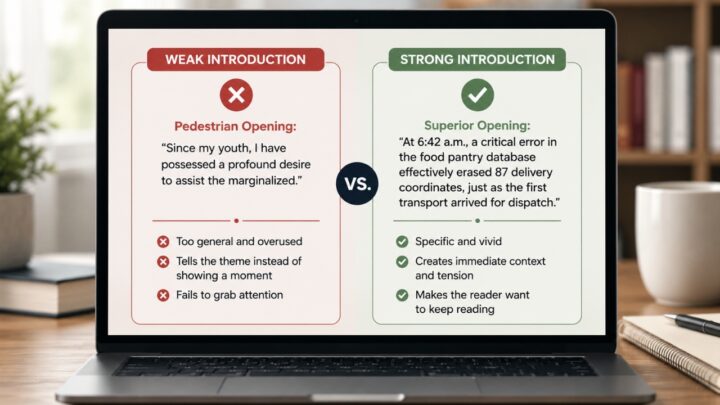
A deficient introduction often relies on universal generalizations or premature thematic explanations rather than immediate narrative immersion.
Admissions officers do not seek platitudes on altruism; they require an immediate justification for their continued engagement with the student’s narrative.
Pedestrian Opening: “Since my youth, I have possessed a profound desire to assist the marginalized.”
Superior Opening: “At 6:42 a.m., a critical error in the food pantry database effectively erased 87 delivery coordinates, just as the first transport arrived for dispatch.”
The refined version establishes temporal and situational stakes, providing a logical foundation for subsequent reflection on problem-solving and systemic impact.
Mistake 2: Choosing A Generic Story
Generic narratives often adhere to predictable archetypes, such as athletic injuries or service-learning trips, without offering a nuanced personal perspective.
These themes only gain merit when the writer transcends the standard trajectory of “challenge leading to enlightenment.”
Institutional guidance, such as Yale’s overview of what Yale looks for, emphasizes the primacy of the applicant’s authentic voice and honest engagement with meaningful experiences.
A conventional narrative structure often obscures this voice by prioritizing a familiar moral arc over idiosyncratic detail.
Optimization requires narrowing the lens. Rather than presenting a broad treatise on teamwork, an applicant should analyze a specific instance of tactical communication under pressure.
Instead of sentimentalizing a relative’s influence, the writer should detail the tangible advocacy or logistical labor performed in that relative’s service.
Mistake 3: Using Vague Examples
Abstract assertions of character, such as “passion” or “resilience,” are ineffective without substantiating evidence. In admissions writing, claims must be verified through granular detail.
Abstract Assertion
Substantiated Evidence
I possess a deep commitment to scientific inquiry.
I conducted longitudinal algae sampling in the local creek to analyze the impact of nitrogen runoff after storm events.
I have demonstrated advanced leadership capabilities.
I restructured the robotics team’s development cycle into 12-minute technical sprints to mitigate deadline slippage.
I am dedicated to community advocacy.
I coordinated bilingual outreach for 23 families, ensuring scholarship compliance through direct linguistic support.
Precision in example selection serves as a proxy for an applicant’s judgment, work ethic, and underlying value system.
Mistake 4: Repeating The Activities List

The personal statement must not function as a prose iteration of the activities section. Its purpose is to provide qualitative depth, exploring motivation, conflict resolution, and cognitive growth that quantitative lists cannot convey.
If an applicant founded a coding initiative, the essay should eschew a chronological history in favor of analyzing a pivotal moment of failure or a critical shift in organizational strategy.
The objective is to provide a human context to the academic and extracurricular record.
As NACAC data indicates, while essays are vital for context, they are supplementary to academic performance.
Therefore, the essay’s function is to humanize the data points already present in the file, rather than attempting to compensate for academic deficiencies.
Mistake 5: Writing A “Why Us” Essay That Could Fit Any College
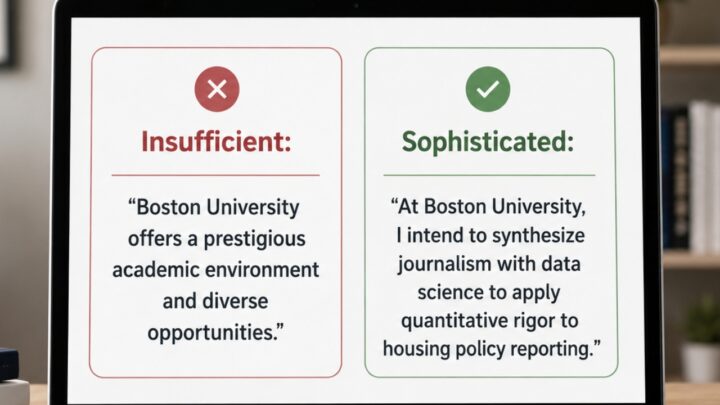
Ineffective institutional fit essays rely on superficial praise regarding campus aesthetics or general reputation.
Rigorous responses establish a clear nexus between the student’s intellectual trajectory and specific university resources, such as specialized curricula, research laboratories, or unique pedagogical models.
Insufficient: “Boston University offers a prestigious academic environment and diverse opportunities.”
Sophisticated: “At Boston University, I intend to synthesize journalism with data science to apply quantitative rigor to housing policy reporting.”
Similarly, the University of California’s personal insight questions are designed to evaluate intellectual curiosity and potential campus contribution within a constrained 350-word format.
This economy of style necessitates a rejection of generic flattery in favor of high-density information.
Mistake 6: Sounding Too Polished Or Adult-Written
Over-refined prose often results in a sterile, detached narrative that obscures the individual. Admissions committees prioritize authentic intellectual maturity over corporate or academic jargon.
Inauthentic Phrasing: “By facilitating interdisciplinary synergies, I leveraged leadership competencies to optimize stakeholder engagement.”
Authentic Phrasing: “I abandoned performative leadership in favor of structured agendas to address our team’s operational fatigue.”
The latter reflects a tangible individual capable of self-critique and practical intervention, qualities highly valued in the holistic review process.
Mistake 7: Treating AI As A Ghostwriter

While AI may serve as a tool for structural diagnostics or grammatical refinement, its use as a primary drafting agent inevitably results in a flattened narrative voice.
An essential heuristic for applicants: every sentence must be defensible as a unique expression of their own perspective.
In 2026, readers are meticulously trained to identify the frictionless, detached tone characteristic of LLMs. Over-reliance on these tools risks a perception of intellectual passivity.
Mistake 8: Ending With A Lesson Instead Of A Change
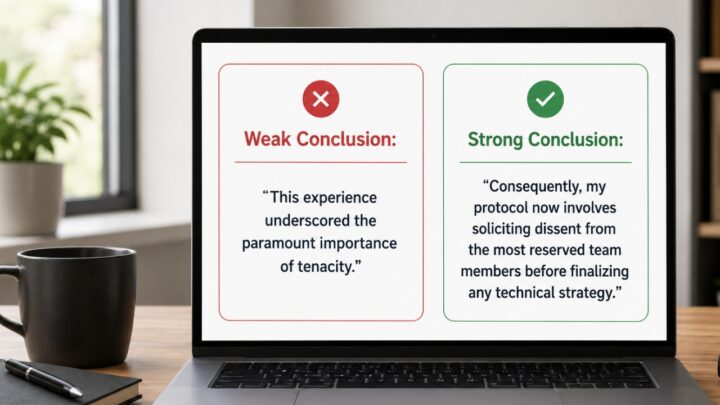
Many essays falter by concluding with a trite moral lesson. A sophisticated conclusion instead demonstrates a shift in behavior, a new line of inquiry, or a revised decision-making process.
Weak Conclusion: “This experience underscored the paramount importance of tenacity.”
Strong Conclusion: “Consequently, my protocol now involves soliciting dissent from the most reserved team members before finalizing any technical strategy.”
The superior conclusion provides empirical proof of growth through habituation, avoiding the pitfalls of rhetorical sentimentality.
Quick Editing Checklist For College Essays
The primary failures in college admissions writing result from a prioritization of safety over substance: broad introductions, archetypal themes, and linguistic over-refinement. A successful essay demands precision, authenticity, and a clear demonstration of the applicant’s intellectual agency. The merit of a personal statement lies not in the rarity of the topic, but in the rigor of the reflection.
Summary
